
Every few years, around a World Cup or a new Premier League season, I watch the same thing happen in my inbox and group chats: people who haven’t bought a sticker pack since they were ten years old suddenly asking where to get the album. It’s a genuinely strange, wonderful thing that’s survived more than half a century basically unchanged – and after years of running SwapMasters around exactly this hobby, I thought it was worth actually tracing where it all started, rather than just assuming it’s “always been Panini.”
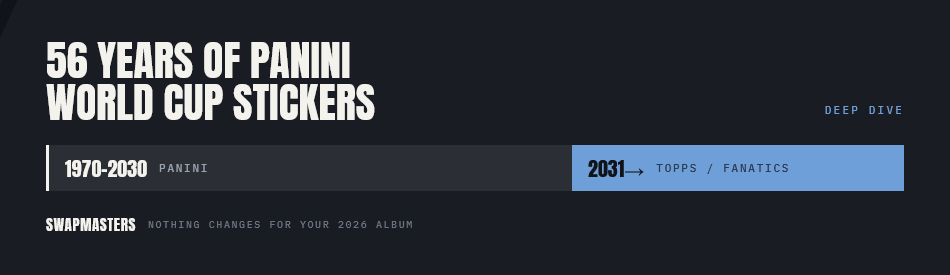
The short answer: the football sticker album began in 1961, when Italian brothers Giuseppe and Benito Panini started selling football figurines from Modena, and it became a World Cup tradition in 1970 with Panini’s first official World Cup album, made for the Mexico tournament. Panini held the World Cup sticker licence on its own for more than fifty years after that, but the picture has changed a lot recently: Topps (owned by Fanatics) now runs the Premier League and Champions League sticker and card licences, Panini has picked up the English Football League instead, and from 2031 Fanatics takes over the FIFA World Cup licence itself, ending Panini’s run.
How it all started, before there was even a World Cup album to make
Panini’s own story starts a few years before any of this. In 1960, brothers Giuseppe and Benito Panini bought an unsold batch of football figurines from a company in Milan and started selling them from their own newsstand distribution business in Modena, in packets of two for ten lire. They sold three million packets that first year. By 1961 – the year the Panini name properly launched as a company – sales had reached fifteen million packets, and the year after that, twenty-nine million. Their brothers Franco and Umberto joined the business in 1963. Within a few years, swapping football figurines had become something close to a national pastime for Italian schoolkids, well before the idea of tying it to a tournament existed at all.
1970: the first official World Cup album
The leap from domestic football stickers to a World Cup product came in 1970, when Panini partnered with FIFA to produce its first official World Cup sticker album, for the tournament in Mexico. It mattered for two reasons: it was the first time Panini sold its stickers outside Italy at all, and it set the template every World Cup album since has followed – national team pages, player portraits, and a scramble to swap the ones you’re missing. The 1970 album was also sold in the UK before the tournament even kicked off, featuring players like Bobby Moore, Pelé and Franz Beckenbauer. The auction house Gildings, which has sold rare surviving copies, has called it “the debut World Cup album that started the enduring worldwide craze of Panini football sticker collecting” – which, having run a business built entirely on that craze still existing, feels about right.
How the album grew, tournament by tournament
What’s struck me most doing this research is just how much the album itself has grown. By some accounts, the 1970 edition ran to a few hundred stickers across 48 pages – modest compared with what collectors deal with today. From there, the growth is well documented tournament by tournament:
- 1974 (West Germany) and 1978 (Argentina): both expanded to around 400 stickers across 48 pages; the 1974 edition is the only one that never named its host country on the cover.
- 1982 (Spain) and 1986 (Mexico): grew to 427 stickers; 1986 made Mexico the first country to host the tournament twice.
- 1990 (Italy) and 1994 (USA): settled around 444-448 stickers, still on 48 pages.
- 1998 (France): the first 32-team World Cup, and the album expanded with it, to 64 pages and 561 stickers.
- 2002 (Korea/Japan) and 2006 (Germany): continued climbing, to roughly 576 and 597 stickers.
- 2010 (South Africa) and 2014 (Brazil): the album reached 640 stickers, spread across 72 and then 76 pages.
- 2018 (Russia): grew again to 80 pages and around 680 stickers, alongside a companion app that, according to Panini, averaged 50,000-60,000 daily downloads and passed 1.5 million users.
- 2022 (Qatar): the most recent “normal-sized” World Cup album, still 80 pages but trimmed slightly to 670 stickers, including 50 special silver foil stickers – the first World Cup held in the Gulf region, and the last Panini album before the format jumped up again for 2026.
That trajectory lands right where SwapMasters’ own collectors found themselves this year: the 2026 album, the first for an expanded 48-team World Cup, runs to 980 stickers across 112 pages – a figure we checked directly against Panini’s own UK pricing when working out what it actually costs to complete it.
Stickers went digital too, without killing off the physical pack
The album’s growth wasn’t only physical. Panini launched a virtual sticker album with Coca-Cola and Tokenzone as early as 2006, available in more than ten languages. By 2018, that had turned into a proper app alongside the printed album. What I find genuinely reassuring, as someone whose entire business depends on the physical side of this hobby, is that none of this seems to have come at the expense of the paper album. Panini America’s own CEO at the time, Mark Warsop, said physical sticker sales didn’t fall as digital collecting grew – 2014 sales were actually up on 2010. The pack, the swap, the gap in the album: none of that got replaced.
Why Panini isn’t the only name on the shelf anymore
For most of this history, “the sticker album” and “Panini” were basically the same thing. That’s no longer quite true, and the last few years have moved fast. Panini signed on to make Premier League cards from the 2019/20 season, but in May 2024 the Premier League switched its sticker and trading card licence to Topps, owned by Fanatics, with the change taking effect from June 2025 – ending Panini’s six-year run with the league. The UEFA Champions League had already made a similar move to Topps back in 2022. Panini hasn’t been shut out altogether, though: from the 2025/26 season it became the English Football League’s first-ever official trading card partner, covering all three EFL divisions plus the EFL Cup and EFL Trophy. And the World Cup licence itself, the one Panini has held continuously since that 1970 Mexico album, is changing too – in May 2026, FIFA signed an exclusive deal with Fanatics for World Cup cards, stickers and card games starting in 2031, closing out a partnership with Panini that had run for more than five decades.
What it means for collectors here in the UK
None of this changes what I’d tell anyone starting out today: the album is still the album, whoever’s name is on the cover. What’s actually changed is who you’ll be buying from depending on the competition – Panini for the EFL, Topps/Fanatics for the Premier League and Champions League, and (for now, until 2031) Panini for the World Cup itself. The hobby has clearly outlasted any one company’s grip on it, and I’d bet it outlasts this current round of licence-swapping too. Fifty-odd years on from Mexico 1970, kids – and plenty of adults who should probably know better – are still tearing open packs hoping for the one sticker they need. That’s the part that hasn’t changed at all.
Frequently Asked Questions
When did Panini make its first World Cup sticker album?
Panini produced its first official World Cup sticker album in 1970, for the tournament held in Mexico, after partnering directly with FIFA. It was also the first time the company sold its stickers outside Italy, including distribution in the UK.
Is Panini still the official World Cup sticker company?
Yes, for now. Panini has held the World Cup sticker licence continuously since 1970, but in May 2026 FIFA signed an exclusive deal with Fanatics covering World Cup cards, stickers and card games from 2031 onwards, which will end Panini’s run with the tournament.
Why did Topps take over Premier League stickers from Panini?
The Premier League moved its trading card and sticker licence from Panini to Topps, owned by Fanatics, in a deal announced in May 2024 and taking effect from June 2025. It followed a similar move by UEFA, which had already switched the Champions League licence to Topps in 2022.
Does Panini still make any UK football stickers?
Yes. While Panini lost the Premier League and Champions League licences, it became the English Football League’s first-ever official trading card partner from the 2025/26 season, covering all three EFL divisions along with the EFL Cup and EFL Trophy.
How many stickers are in the 2026 World Cup album?
The 2026 Panini World Cup album, covering the first 48-team tournament, runs to 980 stickers across 112 pages. SwapMasters checked this figure directly against Panini’s official UK pricing when working out the real cost of completing the album.
Sources
- Sports Illustrated – The Magic, Global Craze and Tradition of Panini’s World Cup Sticker Albums
- Wikipedia – Panini Group
- PrintWeek – Panini Mexico 1970 World Cup album attracts international bidding
- Beckett – 2018 Panini FIFA World Cup Stickers Checklist
- ProSoccer – Panini FIFA World Cup Qatar 2022 Sticker Album
- World Soccer Talk – Topps to Replace Panini for Premier League Cards, Stickers
- Sports Illustrated Collectibles – Panini and EFL Launch Partnership
- ESPN – FIFA to Drop Panini for World Cup Deal With Fanatics in 2031