
Tag: Topps

  • Football Sticker Albums: A History From 1970 to Now

    Football Sticker Albums: A History From 1970 to Now

    Every few years, around a World Cup or a new Premier League season, I watch the same thing happen in my inbox and group chats: people who haven’t bought a sticker pack since they were ten years old suddenly asking where to get the album. It’s a genuinely strange, wonderful thing that’s survived more than half a century basically unchanged – and after years of running SwapMasters around exactly this hobby, I thought it was worth actually tracing where it all started, rather than just assuming it’s “always been Panini.”

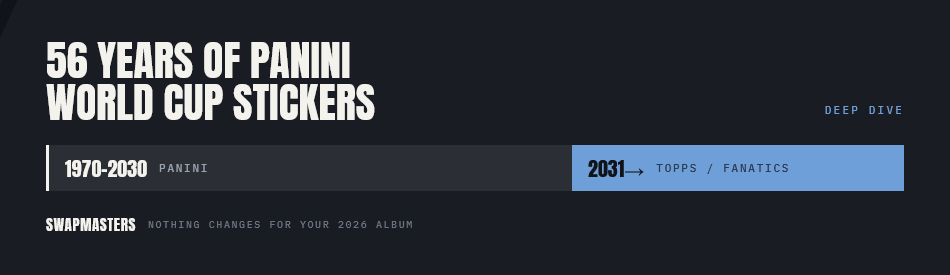
    The short answer: the football sticker album began in 1961, when Italian brothers Giuseppe and Benito Panini started selling football figurines from Modena, and it became a World Cup tradition in 1970 with Panini’s first official World Cup album, made for the Mexico tournament. Panini held the World Cup sticker licence on its own for more than fifty years after that, but the picture has changed a lot recently: Topps (owned by Fanatics) now runs the Premier League and Champions League sticker and card licences, Panini has picked up the English Football League instead, and from 2031 Fanatics takes over the FIFA World Cup licence itself, ending Panini’s run.

    How it all started, before there was even a World Cup album to make

    Panini’s own story starts a few years before any of this. In 1960, brothers Giuseppe and Benito Panini bought an unsold batch of football figurines from a company in Milan and started selling them from their own newsstand distribution business in Modena, in packets of two for ten lire. They sold three million packets that first year. By 1961 – the year the Panini name properly launched as a company – sales had reached fifteen million packets, and the year after that, twenty-nine million. Their brothers Franco and Umberto joined the business in 1963. Within a few years, swapping football figurines had become something close to a national pastime for Italian schoolkids, well before the idea of tying it to a tournament existed at all.

    1970: the first official World Cup album

    The leap from domestic football stickers to a World Cup product came in 1970, when Panini partnered with FIFA to produce its first official World Cup sticker album, for the tournament in Mexico. It mattered for two reasons: it was the first time Panini sold its stickers outside Italy at all, and it set the template every World Cup album since has followed – national team pages, player portraits, and a scramble to swap the ones you’re missing. The 1970 album was also sold in the UK before the tournament even kicked off, featuring players like Bobby Moore, Pelé and Franz Beckenbauer. The auction house Gildings, which has sold rare surviving copies, has called it “the debut World Cup album that started the enduring worldwide craze of Panini football sticker collecting” – which, having run a business built entirely on that craze still existing, feels about right.

    How the album grew, tournament by tournament

    What’s struck me most doing this research is just how much the album itself has grown. By some accounts, the 1970 edition ran to a few hundred stickers across 48 pages – modest compared with what collectors deal with today. From there, the growth is well documented tournament by tournament:

    • 1974 (West Germany) and 1978 (Argentina): both expanded to around 400 stickers across 48 pages; the 1974 edition is the only one that never named its host country on the cover.
    • 1982 (Spain) and 1986 (Mexico): grew to 427 stickers; 1986 made Mexico the first country to host the tournament twice.
    • 1990 (Italy) and 1994 (USA): settled around 444-448 stickers, still on 48 pages.
    • 1998 (France): the first 32-team World Cup, and the album expanded with it, to 64 pages and 561 stickers.
    • 2002 (Korea/Japan) and 2006 (Germany): continued climbing, to roughly 576 and 597 stickers.
    • 2010 (South Africa) and 2014 (Brazil): the album reached 640 stickers, spread across 72 and then 76 pages.
    • 2018 (Russia): grew again to 80 pages and around 680 stickers, alongside a companion app that, according to Panini, averaged 50,000-60,000 daily downloads and passed 1.5 million users.
    • 2022 (Qatar): the most recent “normal-sized” World Cup album, still 80 pages but trimmed slightly to 670 stickers, including 50 special silver foil stickers – the first World Cup held in the Gulf region, and the last Panini album before the format jumped up again for 2026.

    That trajectory lands right where SwapMasters’ own collectors found themselves this year: the 2026 album, the first for an expanded 48-team World Cup, runs to 980 stickers across 112 pages – a figure we checked directly against Panini’s own UK pricing when working out what it actually costs to complete it.

    Stickers went digital too, without killing off the physical pack

    The album’s growth wasn’t only physical. Panini launched a virtual sticker album with Coca-Cola and Tokenzone as early as 2006, available in more than ten languages. By 2018, that had turned into a proper app alongside the printed album. What I find genuinely reassuring, as someone whose entire business depends on the physical side of this hobby, is that none of this seems to have come at the expense of the paper album. Panini America’s own CEO at the time, Mark Warsop, said physical sticker sales didn’t fall as digital collecting grew – 2014 sales were actually up on 2010. The pack, the swap, the gap in the album: none of that got replaced.

    Why Panini isn’t the only name on the shelf anymore

    For most of this history, “the sticker album” and “Panini” were basically the same thing. That’s no longer quite true, and the last few years have moved fast. Panini signed on to make Premier League cards from the 2019/20 season, but in May 2024 the Premier League switched its sticker and trading card licence to Topps, owned by Fanatics, with the change taking effect from June 2025 – ending Panini’s six-year run with the league. The UEFA Champions League had already made a similar move to Topps back in 2022. Panini hasn’t been shut out altogether, though: from the 2025/26 season it became the English Football League’s first-ever official trading card partner, covering all three EFL divisions plus the EFL Cup and EFL Trophy. And the World Cup licence itself, the one Panini has held continuously since that 1970 Mexico album, is changing too – in May 2026, FIFA signed an exclusive deal with Fanatics for World Cup cards, stickers and card games starting in 2031, closing out a partnership with Panini that had run for more than five decades.

    What it means for collectors here in the UK

    None of this changes what I’d tell anyone starting out today: the album is still the album, whoever’s name is on the cover. What’s actually changed is who you’ll be buying from depending on the competition – Panini for the EFL, Topps/Fanatics for the Premier League and Champions League, and (for now, until 2031) Panini for the World Cup itself. The hobby has clearly outlasted any one company’s grip on it, and I’d bet it outlasts this current round of licence-swapping too. Fifty-odd years on from Mexico 1970, kids – and plenty of adults who should probably know better – are still tearing open packs hoping for the one sticker they need. That’s the part that hasn’t changed at all.

    Frequently Asked Questions

    When did Panini make its first World Cup sticker album?

    Panini produced its first official World Cup sticker album in 1970, for the tournament held in Mexico, after partnering directly with FIFA. It was also the first time the company sold its stickers outside Italy, including distribution in the UK.

    Is Panini still the official World Cup sticker company?

    Yes, for now. Panini has held the World Cup sticker licence continuously since 1970, but in May 2026 FIFA signed an exclusive deal with Fanatics covering World Cup cards, stickers and card games from 2031 onwards, which will end Panini’s run with the tournament.

    Why did Topps take over Premier League stickers from Panini?

    The Premier League moved its trading card and sticker licence from Panini to Topps, owned by Fanatics, in a deal announced in May 2024 and taking effect from June 2025. It followed a similar move by UEFA, which had already switched the Champions League licence to Topps in 2022.

    Does Panini still make any UK football stickers?

    Yes. While Panini lost the Premier League and Champions League licences, it became the English Football League’s first-ever official trading card partner from the 2025/26 season, covering all three EFL divisions along with the EFL Cup and EFL Trophy.

    How many stickers are in the 2026 World Cup album?

    The 2026 Panini World Cup album, covering the first 48-team tournament, runs to 980 stickers across 112 pages. SwapMasters checked this figure directly against Panini’s official UK pricing when working out the real cost of completing the album.

    Sources

  • A Brief History of Match Attax: 20 Years of Football Cards

    A Brief History of Match Attax: 20 Years of Football Cards

    Twenty years is a long time for any trading card game to still be turning up in school bags and stocking fillers every autumn. Match Attax has managed it, and the 2026/27 season – its official 20th Anniversary release – is as good a moment as any to look back at how a pack of playground football cards became one of the biggest collecting phenomena in the UK.

    The short answer: Match Attax launched in the UK in 2006, built around the Premier League, and grew into what Topps calls the world’s best-selling sports trading card game, sold across every continent. Within its first decade it expanded beyond English and Scottish club football into UEFA Champions League cards, adding the Europa League alongside it in 2019, and has spent the last few years becoming a genuine collectors’ market as early rookie cards of players like Erling Haaland and Jude Bellingham have sold for thousands of pounds. The 2026/27 Match Attax UEFA Club Competitions set, launched 10 September 2026, marks the 20th anniversary with a fan-voted All-Time 100 Club and a new “Unbeatable 101” card voted for by collectors themselves.

    When did Match Attax actually start?

    Topps launched Match Attax in the UK in 2006, built around the Premier League season, at a time when football sticker collecting already had a long history but a dedicated football trading card game – something you could actually play with your mates, not just stick in an album – was newer ground. It worked: pick your starting XI from your own cards, go head-to-head on attack and defence stats, and whoever’s team scores more wins. Simple enough for a seven-year-old at break time, which is exactly who it was aimed at.

    How did it go from playground game to global brand?

    Within a few years Match Attax wasn’t just an English thing. Topps rolled it out into Scottish football and, eventually, into leagues and competitions across Europe and beyond, to the point where the brand is now sold on every continent and Topps describes it as the best-selling sports trading card game in the world. Along the way it picked up a companion app – over 800,000 registered users by 2019 – and a licensing programme covering everything from stationery to nightwear, which tells you as much about how embedded it became in UK kids’ lives as any sales figure does.

    One thing that’s stayed constant since close to the start is the “101” card – a famously rare, famously coveted insert in nearly every set, the kind of card a generation of collectors can still name their own “first” of (Steven Gerrard’s is often cited by collectors as the original). The “Hundred Club” insert, honouring 100 standout players in a set, has a similarly long history – these aren’t new gimmicks, they’re part of what’s made Match Attax feel collectible rather than disposable from early on.

    Why did Match Attax add the Champions League?

    Within its first decade, Topps had already taken Match Attax beyond English and Scottish club football into the UEFA Champions League, giving it a genuine European audience alongside its domestic UK base – by the mid-2010s the Champions League line had even made its North American debut. In 2019, Topps added UEFA Europa League cards alongside the existing Champions League range, broadening it further. That mattered more than it might sound: it meant a UK collector could pull a card of a player at Bayern Munich or Barcelona in the same binder as their own Premier League team. It’s also, not coincidentally, where a lot of today’s big-money rookie cards come from – Match Attax’s Champions League sets are where early cards of players like Erling Haaland and Jude Bellingham first appeared.

    Is Match Attax actually valuable now?

    For most of its life Match Attax was pocket-money collecting – packs cheap enough for a child’s allowance, nothing that serious adult collectors paid attention to. That’s changed. A 2019 Haaland rookie card from his breakout Salzburg season has sold for around $2,000 in PSA 10 condition; a 1-of-1 Haaland Superfractor from his first full season at Dortmund sold for nearly $5,000. Those are outliers, not the norm – the vast majority of Match Attax cards are still worth exactly what you’d expect a mass-produced card to be worth – but they’re a sign of how seriously the hobby now takes the brand’s rarer pulls, especially rookie cards of players who go on to become genuine stars.

    What’s new in the 20th Anniversary set?

    The 2026/27 Match Attax UEFA Club Competitions set launched on 10 September 2026, built specifically to mark 20 years since the UK launch. The headline feature is the All-Time 100 Club – a set of cards honouring legends of the Champions League era, voted for by fans rather than picked by Topps, featuring names like Messi, Maldini, Ronaldo and Henry. Sitting alongside it is the “All-Time Unbeatable 101,” reviving that classic 101 insert in fan-voted form – Ronaldinho was voted the greatest Champions League Match Attax player of all time for this anniversary edition. The set also introduced a clearer six-tier rarity system (Rare through to Mystical Full-Art) and a run of new insert types. We’ve already gone deep on how those pull rates actually work in a separate post, so we won’t repeat all of it here – but it’s worth knowing this anniversary set is where that rarity system first properly landed.

    Can you swap for the Match Attax 20th Anniversary set?

    If you’re building out this anniversary collection, SwapMasters offers a free checklist to keep track of what you’ve already got and what you still need, so you’re not relying on memory or a scrawled list every time a trade comes up. And when it’s time to actually fill the gaps, we offer swap packages to help you get there – including the rarer cards in the set. Chasing something specific, even one of the harder pulls? Get in touch and we’ll see what we can do.

    Frequently Asked Questions

    When did Match Attax first launch?

    Match Attax launched in the UK in 2006, published by Topps and built initially around the Premier League season. The 2026/27 season marks 20 years since that original launch.

    What is the “101” card in Match Attax?

    The 101 card is one of Match Attax’s longest-running rare inserts, dating back close to the game’s early years. For the 2026/27 20th Anniversary set it returned as the fan-voted “All-Time Unbeatable 101,” with Ronaldinho chosen by collectors as the greatest Champions League Match Attax player ever.

    When did Match Attax add Champions League cards?

    Topps expanded Match Attax into UEFA Champions League cards within its first decade, moving the brand beyond domestic English and Scottish football. UEFA Europa League cards were added alongside the existing Champions League range in 2019.

    Are old Match Attax cards worth anything?

    Most are worth very little, which is normal for a mass-produced, pocket-money card game. The exceptions are early rookie cards of players who went on to become major stars – rare graded examples of Erling Haaland’s and Jude Bellingham’s early Match Attax Champions League cards have sold for hundreds to thousands of pounds.

    What makes the 2026/27 set a 20th Anniversary edition?

    It’s the first Match Attax UEFA Club Competitions release since the brand’s 2006 UK debut to mark that anniversary directly, with a fan-voted All-Time 100 Club, the returning “Unbeatable 101” insert, and a refreshed six-tier rarity system running from Rare up to Mystical Full-Art.

  • Match Attax 2026/27 Pull Rates: What They Actually Mean (And How To Get Them)

    Match Attax 2026/27 Pull Rates: What They Actually Mean (And How To Get Them)

    Every year around this time I get some version of the same message: “what are the actual odds of pulling a dream chase card in the new Match Attax?” This year it’s an even bigger question than usual, because the 2026/27 UEFA Club Competitions set – Match Attax’s 20th anniversary release – launched with a completely new tiered rarity system on top of the old favourites. More tiers means more confusion about what’s actually rare versus what just sounds rare. So let’s go through the real numbers.

    The short answer:

    across a Match Attax 2026/27 Display Box (35 trade packets plus a guaranteed Hero Pack, £65 from Topps), the base rarity tiers run from roughly 1 in 6 packets up to 1 in 216 for a Hyper Rare parallel. The big insert chases sit well beyond that: All-Time 100 Club is about 1 in 12 packets, Infinity about 1 in 24, WHOOSH! around 1 in 540, Enigma around 1 in 2,160, and Mystical Full-Art – the rarest card in the whole set – around 1 in 4,320 packets. Nothing guarantees you a WHOOSH!, Enigma or Mystical card; the only genuinely guaranteed inserts come from specific product formats, not luck.

    What are the rarity tiers in Match Attax 2026/27?

    This year’s set introduced a proper tiered rarity system for the first time, layered on top of the collection’s usual chase-card culture. There are two systems running side by side, and it’s easy to mix them up:

    The base-tier system covers your Base Cards, Leaders and Attax Debutants, each with colour parallels running Rare (green) through Super-Rare (yellow), Mega-Rare (pink), Ultra-Rare (gold) and Hyper-Rare (black). Topps’ own materials state these run from roughly 1 in 6 packets for the most common tier up to 1 in 216 for Hyper-Rare.

    On top of that sits the insert/chase-card system, which is where the real hunt happens: All-Time 100 Club, Infinity, Mirror Foil and Rainbow Foil subsets (Man of the Match Wildcard, Power Play Signature Style, Slick, Attax Master, Goaliath, Fortress, Genuine Genius and Attax Supreme Master), and finally the three ultra-rare chases – WHOOSH!, Enigma and Mystical Full-Art.

    The real pull rates, tier by tier

    Here’s what’s actually confirmed for the insert chases:

    • All-Time 100 Club – 9 fan-voted legends plus a bonus Ronaldinho “All-Time Unbeatable 101” card – roughly 1 in 12 packets
    • Infinity – a 9-card holographic puzzle set – roughly 1 in 24 packets
    • WHOOSH! – 10 Hyper Rare chase cards – roughly 1 in 540 packets
    • Enigma – 10 ultra-premium Hyper Rare cards – roughly 1 in 2,160 packets
    • Mystical Full-Art – just 5 cards, the rarest thing in the set – roughly 1 in 4,320 packets

    For context on how steep that climb is: you’re 360 times more likely to pull an All-Time 100 Club card than a Mystical Full-Art, and even WHOOSH! – itself a proper chase card – is still four times rarer to land than Enigma is common, if that makes sense (Enigma is four times harder to pull than WHOOSH!).

    What does that mean in an actual box?

    A Full Box is 35 regular trade packets plus one guaranteed Hero Pack, for £65 direct from Topps. Working purely off the stated per-packet odds across those 35 regular packets, on average you’d expect to open a WHOOSH! card in roughly 1 box in every 15, an Enigma in roughly 1 box in every 60, and a Mystical Full-Art in roughly 1 box in every 120. Those are averages, not promises – pull rates describe the long run, not any individual box, so plenty of people will open several boxes and get nothing, and a few lucky ones will hit one on their very first packet.

    That’s exactly why the Hero Pack matters. Topps confirms every Full Box’s Hero Pack guarantees a Super Rare base parallel, an All-Time 100 Club card, an Infinity card, and a 20th Anniversary Limited Edition card – regardless of the packet odds above. So if your actual goal is “I want an All-Time 100 Club or Infinity card for certain,” a Full Box already gets you there before you’ve opened a single random packet. WHOOSH!, Enigma and Mystical have no such guarantee anywhere – they’re genuinely down to chance, whichever product you buy.

    Who’s actually in WHOOSH!, Enigma and Mystical?

    Worth knowing before you start chasing:

    WHOOSH! (1 in 540): David Beckham, Désiré Doué, Florian Wirtz, Harry Kane, Jamal Musiala, Lionel Messi, Max Dowman, Pio Esposito, Rayan Cherki and Ronaldo.

    Enigma (1 in 2,160): Bruno Fernandes, Christian Pulisic, Erling Haaland, Hugo Ekitike, Jude Bellingham, Khvicha Kvaratskhelia, Lautaro Martinez, Mohamed Salah, Raphinha and Vini Jr.

    Mystical Full-Art (1 in 4,320): Bukayo Saka, Erling Haaland, Kylian Mbappe, Lamine Yamal and Michael Olise.

    Note that Haaland appears in both Enigma and Mystical – two completely separate cards, two completely separate (and both brutal) sets of odds.

    What’s the best way to actually get one?

    If you specifically want an Infinity card, a Starter Pack (3 packets, £-value entry product) guarantees you one, plus a 20th Anniversary card and a Tactic Combo Card – genuinely the cheapest certain route to an Infinity, rather than gambling on packet odds. A Full Box’s Hero Pack does the same job for both Infinity and All-Time 100 Club in one go.

    For WHOOSH!, Enigma or Mystical, there’s no shortcut – no product guarantees them, so it really is a case of packets opened versus luck. The only lever you can genuinely pull is volume: more packets opened means more shots at those odds, nothing more mysterious than that. If your budget only stretches to a handful of packets, it makes more sense to go in expecting the guaranteed inserts (base parallels, Mirror/Rainbow Foil, and an Infinity or All-Time 100 Club if you buy a Full Box) and treat a WHOOSH!, Enigma or Mystical pull as a genuine bonus, not the plan.

    A word on where these numbers come from

    The pull rates above are Topps’ own stated packet odds, and I’ve cross-checked the specific figures – and the WHOOSH!/Enigma/Mystical player lists – across two independent sources reporting on Topps’ official release materials, so I’m confident in them. The base-tier odds (1 in 6 to 1 in 216) and the Hero Pack/Starter Pack guarantees come directly from Topps’ own UK store and its Ripped blog. As always with a set this new, individual box variance is real – these are the rates Topps has published, not a guarantee of what you personally will open.

    Frequently Asked Questions

    What are the pull rates for Match Attax 2026/27 insert cards?

    All-Time 100 Club is roughly 1 in 12 packets, Infinity roughly 1 in 24, WHOOSH! roughly 1 in 540, Enigma roughly 1 in 2,160, and Mystical Full-Art roughly 1 in 4,320. These are Topps’ own stated packet odds for the regular trade packets in Match Attax 2026/27.

    Is there a guaranteed way to get an Infinity or All-Time 100 Club card?

    Yes. A Full Box’s Hero Pack guarantees both an Infinity card and an All-Time 100 Club card, alongside a Super Rare base parallel and a 20th Anniversary Limited Edition card. A Starter Pack alone also guarantees an Infinity card.

    Can you guarantee a WHOOSH!, Enigma or Mystical Full-Art card?

    No. None of the current Match Attax 2026/27 products carry a guaranteed WHOOSH!, Enigma or Mystical Full-Art card. They’re only available through the stated random packet odds, which range from roughly 1 in 540 to 1 in 4,320.

    How many cards are in the WHOOSH!, Enigma and Mystical Full-Art sets?

    WHOOSH! and Enigma each contain 10 cards. Mystical Full-Art is the smallest and rarest set in the collection, with just 5 cards.

    How much is a Match Attax 2026/27 Full Box and what does it include?

    A Full Box costs £65 direct from Topps and includes 35 regular trade packets plus one guaranteed Hero Pack containing a Super Rare base parallel, an All-Time 100 Club card, an Infinity card and a 20th Anniversary Limited Edition card.

    Sources


  • The Autograph Phenomenon: Why Are Signed Cards So Expensive, and Where Do They Actually Get Sold?

    The Autograph Phenomenon: Why Are Signed Cards So Expensive, and Where Do They Actually Get Sold?

    Autographed cards get talked about like they’re the top of the food chain – the ultimate pull, the thing every box breaker is secretly hoping for. So it’s worth asking the question properly: why do they cost what they cost, and once you own one, where does it actually go if you want to sell it? The answers aren’t quite what most people assume.

    The short answer: signed football cards cost more because of a manufactured scarcity, not the signature alone – most modern autographs are hand-numbered to a few hundred copies or fewer, and many are actually redemption cards (a promise of a future signature, not cardboard in hand). The genuine record prices in the hobby, however, belong to rare unsigned rookies in top grade – not autographs. Most football/soccer autographs are bought and sold on eBay; the high end of the market runs through Fanatics Collect and Goldin Auctions.

    It’s not actually the top of the market

    Here’s the bit that surprises people: the genuine record prices in football/soccer cards aren’t autographs at all. A 2004-05 Panini Mega Cracks Lionel Messi rookie, graded PSA 10, sold in a private sale brokered by Fanatics Collect for $1.5 million. A 2018 Panini Kaboom! 1-of-1 green parallel of Cristiano Ronaldo, also PSA 10, sold through the same platform in May 2026 for $1.35 million. A 1958 Alifabolaget Pelé rookie card, PSA 9, sold for $1.33 million back in February 2022. None of the three are signed.

    What that tells you is that the very top of this hobby is driven by scarcity, condition and subject matter – the rarest surviving copy, in the best surviving grade, of the most important player – not by a signature. Autographs absolutely command a premium over an unsigned version of the same card, but they’re competing in a different, much larger tier of the market: hundreds to low thousands of pounds for most modern football/soccer autos, not seven figures.

    The catch nobody mentions: a lot of “autographs” are actually a promise

    A huge chunk of what collectors think of as “the autograph pull” isn’t a signed card in your hand at all – it’s a redemption card. You open the pack, pull a card that says something like “redeem this for your genuine autograph,” post it off (or register it), and wait for the manufacturer to actually get the card in front of the player to sign before sending you the real thing.

    That wait can be long. Topps publicly extended its redemption expiry window from two years to ten years for anything from 2021-22 products onward, announced in April 2024 – meaning a redemption issued in a 2022 product that would previously have expired in 2024 is now valid until 2032. The same announcement noted Topps had cut its backlog of owed redemptions from roughly 70,000 down to under 10,000 over the preceding year – which the industry press rightly pointed out is still a lot of collectors waiting on a signature that hasn’t happened yet. That backlog, and the years-long fulfilment windows, are baked into how the market prices autographs: part of what you’re paying for is provenance and guarantee, not just ink on cardboard.

    Small print runs, hand-numbered by design

    The other reason autographs carry a premium is that they’re deliberately made scarce, and the football/soccer side of the hobby is no exception to how the wider industry does this. We covered this in detail a couple of weeks back looking at Topps’ UCC Match Attax range: the genuine autograph programme for that release covered 23 named players against a combined global print run of 5,000 signed cards – an average of around 217 copies per player, unevenly distributed in practice. On-card autographs from Panini’s promotional programmes follow the same pattern elsewhere in the hobby: individual listings for their Player of the Day autographs, for example, show cards hand-numbered to as few as 40 copies for a single player. When a checklist has a few hundred players and each one only gets a double- or triple-digit print run of autographs, ordinary pack-opening odds alone explain most of the price.

    So where do they actually get bought and sold?

    For the vast majority of football and soccer autographs – the ones ordinary collectors pull, buy and swap – eBay is still where most of the buying and selling actually happens, in the UK as much as anywhere. That’s true whether it’s a Match Attax genuine autograph or a lower-tier Panini signed insert.

    The top end of the market has consolidated hard, though. Fanatics bought PWCC Marketplace and folded it into a rebranded platform, Fanatics Collect, in 2024, absorbing PWCC’s auction listings, fixed-price marketplace, vaulting and authentication services into one operation – and that’s the platform behind both of the seven-figure sales mentioned above. Goldin Auctions remains the other major venue for genuinely high-end pieces going under the hammer. Between them, Fanatics now sits on both sides of a lot of this market: it owns Topps (the manufacturer producing the autograph in the first place) and, through Fanatics Collect, one of the biggest resale platforms for it too.

    What this actually means if you’re chasing one

    None of this should put anyone off going after a signed card – they’re genuinely special things to own, and the story behind getting one is often as good as the card itself. But it’s worth knowing what you’re actually paying for: with modern releases, a decent chunk of the price reflects a tiny, deliberately engineered print run and, quite often, a manufacturer’s promise rather than cardboard already in an envelope. Ask what you’re actually going to receive and when, especially if what’s on offer is a redemption slip rather than the finished card – and remember that outside a handful of genuinely historic rookies, it’s rarity and grade, not the signature alone, that decides whether a card is worth hundreds or millions.

    Frequently Asked Questions

    Are autographed cards the most valuable football cards?

    No. The genuine record sales in football/soccer cards – including a $1.5 million Messi rookie and a $1.35 million Ronaldo 1-of-1 – are unsigned. Rarity, condition, and subject matter drive the very top of the market, not a signature.

    Why are football autograph cards so expensive?

    Deliberately small print runs. Many modern autograph programmes are numbered to a few hundred copies per player, sometimes as few as 40. Ordinary scarcity, not the ink itself, explains most of the price.

    What is a redemption card?

    A card that promises a future autograph rather than delivering one immediately – you send it off or register it, and the manufacturer arranges for the player to sign it later. Wait times can run for years; Topps extended its redemption expiry window to 10 years in 2024.

    Where can I buy or sell football autograph cards?

    Most everyday autographs change hands on eBay. High-end pieces typically go through Fanatics Collect or Goldin Auctions.


    Sources: Cardbase (independent “10 Most Expensive Soccer Cards” analysis) and QP Market Network (independent “Most Expensive Soccer Cards” ranking), cross-checked against each other for the Messi, Ronaldo and Pelé sale prices and dates; Sports Collectors Daily and OTIA (Topps redemption policy change, April 2024); Fanatics Inc. official press release (Fanatics Collect launch and PWCC consolidation, 2024); Sportico (Fanatics Collect market reporting); eBay listings (on-card autograph numbering examples); previously verified SwapMasters research on Topps UCC Match Attax 2025/26 autograph print runs (Topps Ripped UK blog and Cardboard Connection, January 2026).

  • Topps Takes Over the World Cup License in 2031

    Topps Takes Over the World Cup License in 2031

    Big news dropped back in May and it’s still worth talking through properly, because it’s the kind of story that gets flattened into a scary headline (“Panini loses the World Cup!”) when the real details are more interesting and, frankly, less urgent than that makes it sound.

    Here’s what actually happened: FIFA and Fanatics announced an exclusive global collectibles agreement covering trading cards, stickers, and trading card games — physical and digital — for football’s biggest tournaments. The cards will be made under the Topps brand, because Topps is owned by Fanatics rather than being the other party to the deal directly. It’s a genuinely big deal in the collecting world, ending a relationship between FIFA and Panini that’s run since 1970 — 56 years, missing only the 1994 World Cup along the way.

    The bit that actually matters for you right now

    Here’s the part that gets lost in the noise: this doesn’t kick in until 2031. Panini keeps its World Cup sticker and card rights for both the 2026 tournament (the one happening right now across the US, Mexico and Canada) and the 2030 edition. So if you’re mid-way through filling this year’s album, nothing changes — you’re not suddenly collecting the wrong brand. The 2031 date, for context, is presumably tied to the next World Cup cycle after 2030, whenever and wherever that ends up being hosted.

    This isn’t a one-off, either. It’s the same pattern Fanatics has been running for a few years now — Panini has already lost UEFA, the Premier League, and licenses across the NBA, NFL, MLB and Bundesliga to Fanatics one by one. The FIFA deal is the biggest domino yet, given how much of the whole hobby’s identity is wrapped up in that blue World Cup sticker album, but it’s very much part of a longer trend rather than a bolt from nowhere.

    The genuinely interesting bit: debut patches, starting now

    The part of this story I actually find exciting rather than just noteworthy is the “debut patch” programme, and it’s happening at this exact World Cup, not in 2031.

    Any player making their first-ever World Cup appearance this tournament — the reporting specifically flags names like Lamine Yamal, Michael Olise, and returning-nation debutants from teams like Scotland, Norway and Austria — will wear a special patch on their shirt for that match. After the game, the patch is removed and authenticated, with the plan being to mount it permanently onto a numbered trading card. Combined across the 2026 and 2030 tournaments, reporting suggests this could produce 600-plus individual debut patch cards — genuine match-worn memorabilia tied to a player’s actual first World Cup appearance.

    The catch, and it’s a real one: because the Topps World Cup license doesn’t formally begin until 2031, none of these cards can actually be sold or released to collectors until after that point. So the patches are being collected and authenticated now, in real time, but you won’t be able to chase one down for a few years yet. If a Yamal or a Haaland-type debutant becomes one of the game’s biggest names in the meantime, that lag could make an early patch card seriously desirable by the time it finally reaches the market.

    The lawsuit in the background

    Worth knowing, because it’s genuinely still live: Panini has an active antitrust lawsuit against Fanatics, accusing it of anticompetitive behaviour across the wider collectibles market — not specific to football. That case survived an attempt to have it dismissed, and as of the most recent public filings, it’s in the discovery phase with no trial date set. Separately, a group of individual consumers filed their own, similar class-action lawsuit against Fanatics and several major US leagues; that one was thrown out by a federal judge in March this year, on the grounds that none of the named plaintiffs could show they’d actually overpaid for anything. The two cases aren’t the same lawsuit, and only one of them is still going — but it’s a reminder that this whole transition is happening against a genuinely contested legal backdrop, not just a straightforward changing of the guard.

    What this actually means for us

    Practically, nothing changes today. Keep collecting the 2026 Panini album the same as always — it’s not going anywhere for this tournament or the next one. But it’s worth understanding why you’re likely to see a lot more Topps product on the football side over the next few years, across club and international football alike, and why a name like Topps that’s mostly associated with baseball and NFL cards in a lot of people’s heads is about to become a much bigger part of the football collecting world too.

    We’ll keep half an eye on this one as it develops — particularly the lawsuit, and whatever eventually happens with those debut patch cards once 2031 actually arrives.